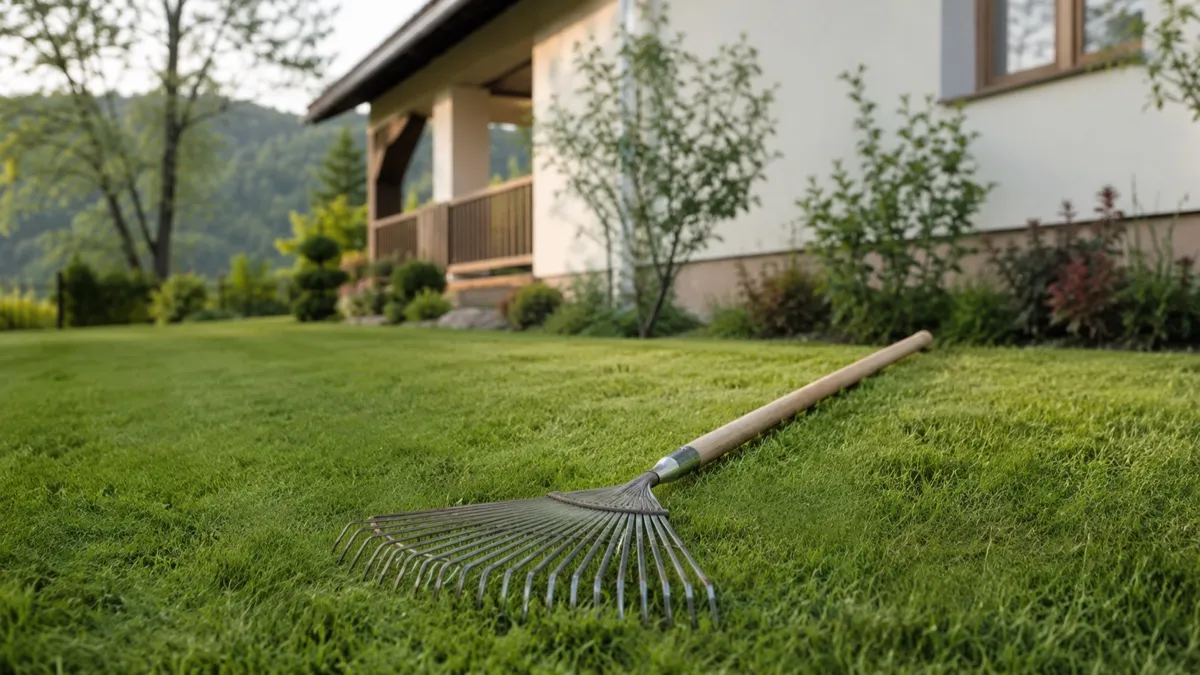
Aeration, Scarification, Mulching: What They Are, Done Right
Aeration, scarification, mulching, feeding, liming, overseeding — what these lawn jobs are in Slovenia, why they matter, and how to do each one properly.
The mattress is the one thing in the home you spend a third of your life in direct contact with, and at the same time the one almost nobody maintains. A sheet is changed once a week, while the mattress beneath it may go a decade without a clean.
This article is about how to tell the moment has come, what actually lives inside, and what timing to treat as normal.
Over a night an adult loses roughly half a litre of moisture and about a gram of skin flakes. Over a year that’s some 180 litres of moisture and a third of a kilogram of organic matter, a significant part of which goes not into the sheet but deeper — into the filling.
Plus: sweat and its salts, sebum, residues of creams and cosmetics, hair particles, household dust, and pet hair if they sleep on the bed.
This isn’t about squeamishness. It’s about a stable environment building up inside the mattress — warm, humid, with food available. For one particular resident, those are ideal conditions.
A dust mite is a microscopic arthropod about 0.3 mm in size, invisible to the naked eye. It doesn’t bite, doesn’t drink blood and doesn’t carry disease. It feeds on dead skin flakes — yours and your pet’s.
The conditions in which it multiplies: 20–25 °C and humidity above 50%. A mattress you’ve slept on for a night hits those parameters exactly.
The problem isn’t the mites themselves but their waste products. The proteins in their droppings and chitin remains are what trigger the allergic reaction — one of the most common household allergens in the world.
What it looks like in everyday life:
The key sign is a link to the bedroom and to sleep time. If symptoms worsen at home in bed and ease when you go away for a week’s holiday, that’s a strong argument for a household allergy.
Visible:
By smell:
By symptoms:
By events:
By the calendar: you can’t remember when you last cleaned the mattress. That sign alone is enough.
| Situation | How often |
|---|---|
| Normal use, adults | every year to eighteen months |
| An allergy or asthma sufferer | once a year, better twice |
| A child’s bed | once a year |
| Pets sleep on the bed | once a year |
| A long-term rental | between tenants |
| A short-term rental | once a season plus between longer stays |
| A guest bed used rarely | every two years |
Separately: a mattress typically lasts 8–10 years. If yours is older and sagging too, cleaning won’t fix the problem. It’s more honest to replace it.
In order of effectiveness, from the most powerful to the supporting.
1. Humidity below 50%. The most effective measure and at the same time the most underrated. A mite doesn’t drink water, it takes moisture from the air. At a stable humidity below 50% the population doesn’t grow. Airing, a dehumidifier in the bedroom, no drying laundry in the bedroom.
2. Washing bedding at 60 °C. At this temperature mites die. At 40 °C they survive. Once every one to two weeks.
3. Professional mattress cleaning. Removes the bulk of the mites and, above all, the accumulated allergen. A one-off but noticeable reset.
4. An anti-mite mattress cover. A dense fabric the allergen can’t pass through. For an allergy sufferer it’s comparable to a clean in effectiveness and works continuously.
5. Air the bed in the morning. Don’t make the bed straight away — let the moisture from the mattress escape for at least half an hour. Free, and it works.
6. A HEPA-filter vacuum over the mattress. Once a month. An ordinary vacuum without HEPA partly blows the allergen back into the air — a debatable effect.
7. Remove excess textiles from the bedroom. Rugs, heavy curtains, soft toys on the bed — all of that is housing for the mite too.
What you should not do: don’t douse the mattress with household products or try to “rinse” it yourself. Water that went into the filling and wasn’t extracted means mould and odour within a week.
If professional cleaning is a way off and you want to do something:
That will give a tangible result against mites and odour. What it won’t give: stains and deep soiling will remain, because you can’t get them out without extraction.
The mattress in a rental is the item people skimp on most often, and wrongly. For a tenant, the state of the mattress is one of the first signals of how the owner treats the property. A clean mattress in the listing means both a faster let and grounds to hold your rate.
A practical scheme: cleaning between tenants plus an anti-mite cover that’s changed or washed at each tenant change. The cover is cheaper than an unplanned clean, and it protects the mattress from what makes it unusable before its time.
If you’re not in Slovenia, this is exactly the task to hand over together with preparing the property between tenants.
We clean mattresses with wet extraction: a solution is driven deep into the fibre and drawn back out together with the dirt. As a separate option — an anti-mite treatment, if there’s an allergy sufferer or a small child in the home.
The price list is published in full on the upholstery and mattress cleaning page: no inspection needed, the price is known up front, travel and cleaning agents included. Most often mattresses are cleaned together with a sofa or in one visit with a deep clean — cheaper than two separate visits.
For those who rent out, there’s a subscription of two visits a year — we remind you ourselves when it’s due.
The simplest way to discuss it: message us through the form or on WhatsApp.
How often should a mattress be cleaned? Every year to eighteen months for normal use. With allergies, pets in the bed, a small child or a rental — once a year or more. In a rental — between tenants, regardless of the calendar.
Does cleaning help against dust mites? Yes, but partly and not forever. Cleaning removes the bulk of the mites and the accumulated allergen. The population recovers within a few months, so cleaning is combined with humidity control, washing bedding at 60 °C and an anti-mite cover.
Can I clean a mattress myself? Superficially, yes, and it’s worth doing: vacuum, soda, airing, sun. But you can’t wash soiling out of the depth of the filling with household means, and wetting a mattress without professional extraction is risky — the water stays inside.
How long does a mattress take to dry after cleaning? 4–8 hours with normal ventilation. With forced drying — 2–3 hours. Don’t sleep on a not-fully-dry mattress: residual moisture in the filling causes odour.
Do both sides need cleaning? If you flip the mattress regularly — yes, both. If you always sleep on one side, the working side is enough, but every few years it makes sense to do both.
Does putting the mattress in the sun help? Yes, it’s one of the few free measures that genuinely work. Ultraviolet and dryness reduce the mite population in the top layer. A few hours in direct sun, ideally on a dry, breezy day.
My mattress is 12 years old — is it worth cleaning? Probably not. A mattress typically lasts 8–10 years. If it’s sagging too, cleaning will restore the look but not the support. The money is better put towards a replacement.
A mattress gives no signals until the problem becomes obvious. It’s easier to stick to a simple rule: every year to eighteen months, a clean; once a week, bedding at 60 degrees; bedroom humidity below 50%. That’s enough not to think about the subject at all.
If someone in the home sleeps poorly or wakes with a blocked nose — message us, and we’ll suggest where to start.
Aeration, scarification, mulching, feeding, liming, overseeding — what these lawn jobs are in Slovenia, why they matter, and how to do each one properly.
How to work out what makes more sense for your property in Slovenia — a Property Care subscription or one-off visits as tasks arise. The logic of the break-even point and what to compare beyond money.
An honest breakdown of the cost of maintaining an apartment in Slovenia under remote ownership: mandatory payments, seasonal costs and the hidden expenses people forget.
Tell us about your situation — we'll agree on the format and a fixed price. The first assessment visit is free.