Moving Furniture Within a Property: 6 Situations When You Need It
What moving furniture within an apartment or house in Slovenia means: the 6 situations when you need it, what the service covers, and how it differs from a full move.
An apartment or house in which no one lives and which no one is looking after is effectively in a state of dormancy — like equipment put into storage. The home doesn’t “switch off,” but it goes still: the air stagnates, dust settles, the building systems stand under no load. This isn’t a breakdown or neglect — it’s the normal state of a pause. But because of it, arrival and departure aren’t “open the door” and “close the door” but two separate procedures: start-up and shutdown.
This article is a practical breakdown of both transitions: how to properly start up a home after a long absence and how to sensibly close it down when you leave. It walks through the typical problems and explains that almost all of them can be handled yourself, with no special skills. What’s needed isn’t tools but attention and a sequence of steps.
The material draws on Slovenian practice and years of experience from the DomCare team preparing properties for owners’ arrivals and for their departures.
When no one lives in an apartment for months, it doesn’t stand “exactly as it was.” Slow processes run inside it: the air stagnates and takes on a stuffy smell even in an immaculately cleaned home; dust settles on every surface — it appears not from dirt but simply out of the air; the water in the traps dries out, and the drains start to give off a sewer smell; the building systems — boiler, water heater, air conditioning — sit unused.
None of this is an emergency. This is dormancy — the natural state of a pause. What matters is something else: since the house was dormant, you can’t simply “switch it on.” It needs to be started up — step by step and with a buffer of time. And just as much, you can’t simply “abandon” it when you leave: it needs to be put into dormancy deliberately, otherwise by your next arrival the pause turns into a problem.
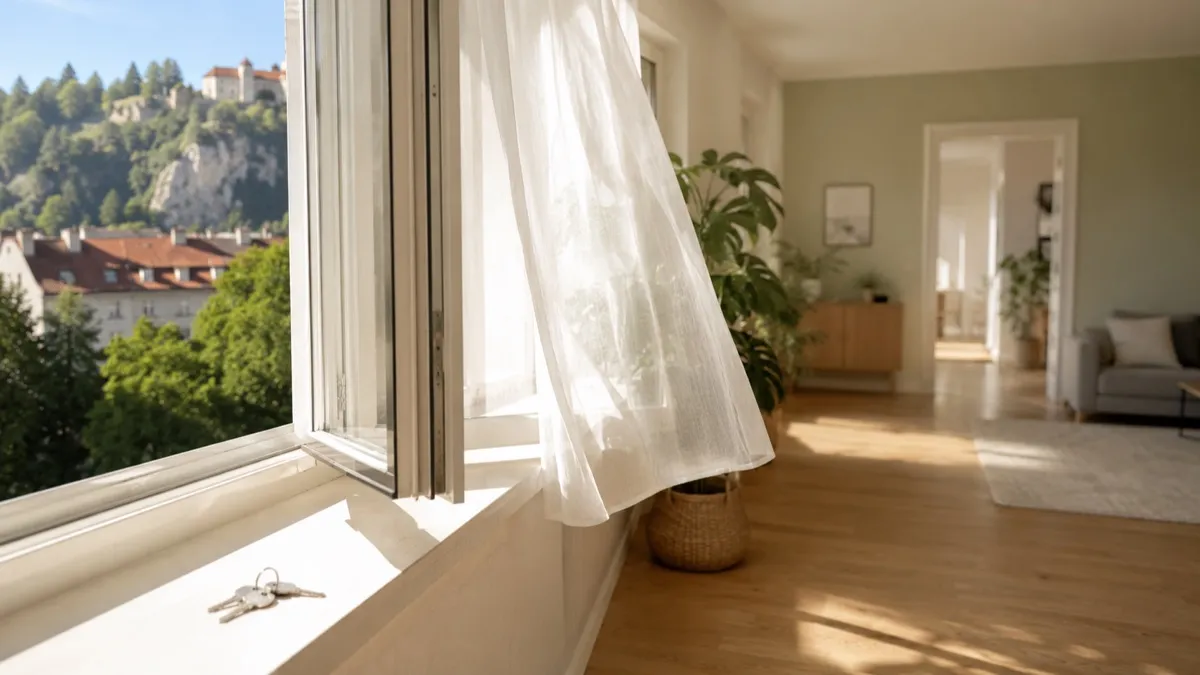
The first thing to do on the threshold is to open the windows. The stuffy smell of a closed-up space doesn’t clear in fifteen minutes: the air needs several hours of cross-ventilation. So you start airing it straight away — and leave it running in the background while you deal with everything else. If you can open windows on different sides and create a through-draught, the smell clears faster.
While the house airs out, it makes sense to tackle the dust. Over the standstill it has settled on every horizontal surface, no matter how clean things were when you left. The logical order is top to bottom: shelves, countertops and windowsills first, the floor last. That way the dust you stir up settles on surfaces not yet cleaned, rather than on ones already wiped.
For cleaning you need at least basic supplies. If you left cleaning products in the house when you departed — good; if not, it’s worth buying them in advance or bringing them with you, so you don’t find yourself in an un-started-up apartment with nothing at all. It’s a small thing, but it’s small things that drag out the first day.
A separate and the most important part of start-up is the building systems. Heating, the water heater and the air conditioning need not just to be switched on, but switched on and watched.
The reason is simple: equipment that has stood unused for a long time fails precisely at the moment of start-up, not later, in steady running. A boiler, a circulation pump, an air-conditioning compressor calmly “see out” the pause switched off, but the first start-up under load is a stress test for them. If something fails, that almost always shows up in the first day after the start, not a week later.
Two practical conclusions follow. First: you start up the equipment at the very beginning, not at the last moment before you need it. Give the systems a day to run under your watch. Second: once you’ve started it up, don’t go away for long. Switching the heating on and heading out for the whole day is a bad idea; these are exactly the hours to be nearby and see how everything behaves.
The same logic applies to water. Open the valves shut off for the period of your absence — and when pressure returns to the system, go round the joints: after a standstill a connection can start to “weep” precisely when the water returns. Run the water at the taps, check the water heater.
From all of the above follows a sober expectation: a home doesn’t return to normal life at the snap of a finger. Even a simple apartment can’t be started up in under a day — it needs airing, cleaning, warming up or cooling down to a comfortable temperature, opening the shut-off valves and making sure everything works. For a house, especially a country house, allow two or three days.
So it’s better to plan your arrival with a buffer — to arrive two or three days before the moment the house has to be fully “liveable,” or to arrange in advance for someone to start it up before you get there. Then you walk into a ready home, not a cold apartment with stuffy air.
People think about this part less often. After you’ve lived in the house for a while, it feels like it’s enough to “lock up and leave.” But it’s precisely how you closed the house down that determines what you’ll find at your next arrival. A careless shutdown means smells, mould and surprises that you’ll then have to scrub and fix, losing time and nerves.
A proper departure has three parts: clean the house, switch the building systems into a dormant mode, and close it down properly. Below is a list of the things people most often overlook.
Cleaning first. You need to put a clean house into dormancy. Any dirt left behind turns, over months of a closed-up space, into exactly the smell that will greet you on the threshold. Cleaning before departure isn’t politeness — it’s prevention.
The fridge — the classic mistake. It feels like it’s enough to wipe it out, unplug it and close it. But, first, a hastily wiped fridge is almost never wiped perfectly; second, moisture remains inside. A closed, switched-off fridge with residual moisture “blooms” over a few weeks — and greets you with a heavy smell, and sometimes mould. The right way is either to leave the doors loosely ajar so the interior airs out, or to give the fridge at least a day switched off and open to fully dry out. The most reliable option is still to leave the doors ajar.
The dishwasher and washing machine — the same story. Water remains in the drum and in the folds of the seal. If you close the door tightly, the moisture has nowhere to go and over the standstill turns into mould and a smell you’ll then have to get rid of. Leave the doors ajar, wipe the filter and seal dry.
Water. The shut-off main valve is the most important measure: it makes a leak in an empty house physically impossible. For details on preparing for a long departure — see the article “Going away for 3 months”.
Traps. If the house is going to stand for a long time, the water in the traps will dry out and a sewer smell will appear — not an emergency, but unpleasant. It’s worth at least keeping this in mind so the smell on your return isn’t a surprise.
Electrics. Unplug whatever shouldn’t stay live, and check the fuse box.
A separate piece of advice from practice that saves hours at the next arrival. When you shut off the water and cut the power to some sockets and circuits, it feels like you’ll certainly remember it all. A few weeks later — especially if it’s not you but someone else coming to the house — no one will. The typical picture at start-up: part of the house has no water or a socket isn’t working, the person walks around hunting for what’s been shut off where, and spends an hour on it.
The solution is simple: write it down. A short list — which valve is shut off, which breaker is switched off — left on the inside of the front door or on the fuse box door removes the problem completely.
And second: don’t shut off more than you need to. If shutting one main inlet valve is enough to protect against a leak, there’s no need to additionally close all the local taps as well. The less is shut off, the less there is to forget to open.
Everything described here you can do yourself. There’s nothing complicated about it: it’s not a matter of skill but of attention and a sequence of steps. The catch is something else — it’s a full procedure, not a ten-minute job. Starting up a home takes two or three days with mandatory watching of the equipment; the shutdown is a careful clean plus putting all the systems properly “to sleep.” And all of it has to actually be done, not skipped “because I’m tired from the journey” or “I’m already late for the airport.”
This is exactly what the arrival-and-departure service is built on. In essence it’s the same procedure, only carried out by someone on the ground. Depending on the situation it’s one visit or several: before your arrival — cleaning and start-up, then checking that everything works (sometimes more than once — because equipment breakdowns show up precisely at start-up); after your departure — the same cleaning, a proper shutdown of all the systems and a sensible closing-down of the house. You can do it yourself. You can hand it to people for whom it’s routine work.
At DomCare, arrival and departure preparation is a full cycle around your dates. Before arrival: cleaning, airing, starting up and checking the building systems, so you walk into a ready, warm, working home. After departure: cleaning, switching the systems into dormancy, closing down the house with a record of what’s been shut off. Depending on the situation it’s one one-off visit or several visits, and for houses that stand empty for long stretches, arrival preparation is a natural part of property care. We work in Ljubljana, on the coast, in the Bled and Bohinj region and in the Kranj region.
The easiest way to talk it through: write to us via the form or on WhatsApp.
Why does a closed-up apartment develop a smell if it was clean before I left? The smell comes from stale air and dried-out water in the traps, not from dirt. That’s why it appears even in an immaculately cleaned home — and why starting up needs several hours of airing.
Can a home be started up in a single day? A simple apartment — only just: airing it, cleaning, warming it up, opening the valves and checking everything in under a day is hard. For a house, allow two or three days and plan your arrival with a buffer.
Why watch the equipment rather than just switch it on? Heating, the water heater and the air conditioning mostly fail at the moment of start-up after a long standstill, not in steady running. If you switch it on and leave, you’ll discover the fault too late.
What’s the right way to leave the fridge when I go? Clean it, unplug it and leave the doors loosely ajar so the interior airs out. A closed fridge with residual moisture develops mould and a heavy smell over a few weeks.
Why write down which valves are shut off? A few weeks later no one remembers what was shut off where. A list on the inside of the door or on the fuse box saves an hour at start-up of hunting for why there’s no water or power.
A closed-up house is a dormant property, and it has to be treated accordingly: started up after the pause step by step and with a buffer of time, and before departure switched into dormancy just as deliberately. Get both transitions right — and the house won’t greet you with smells, cold and breakdowns, and the pause between arrivals stays just a pause.
If you’d like the house to be ready for your arrival or carefully closed down after your departure — write to us.
What moving furniture within an apartment or house in Slovenia means: the 6 situations when you need it, what the service covers, and how it differs from a full move.
What property clearing in Slovenia is, how the process works, the situations where it's needed, and how to approach clearing an inherited home with care.
What practical help a property buyer in Slovenia needs at every stage: inspecting the property, being there during the process, handover and preparation after the deal.
Tell us about your situation — we'll agree on the format and a fixed price. The first assessment visit is free.