Sofa cleaning at €20 and at €90: what's the difference
Why upholstery and mattress cleaning prices in Slovenia differ fourfold, how dry UV treatment differs from extraction, and what you're actually paying for.
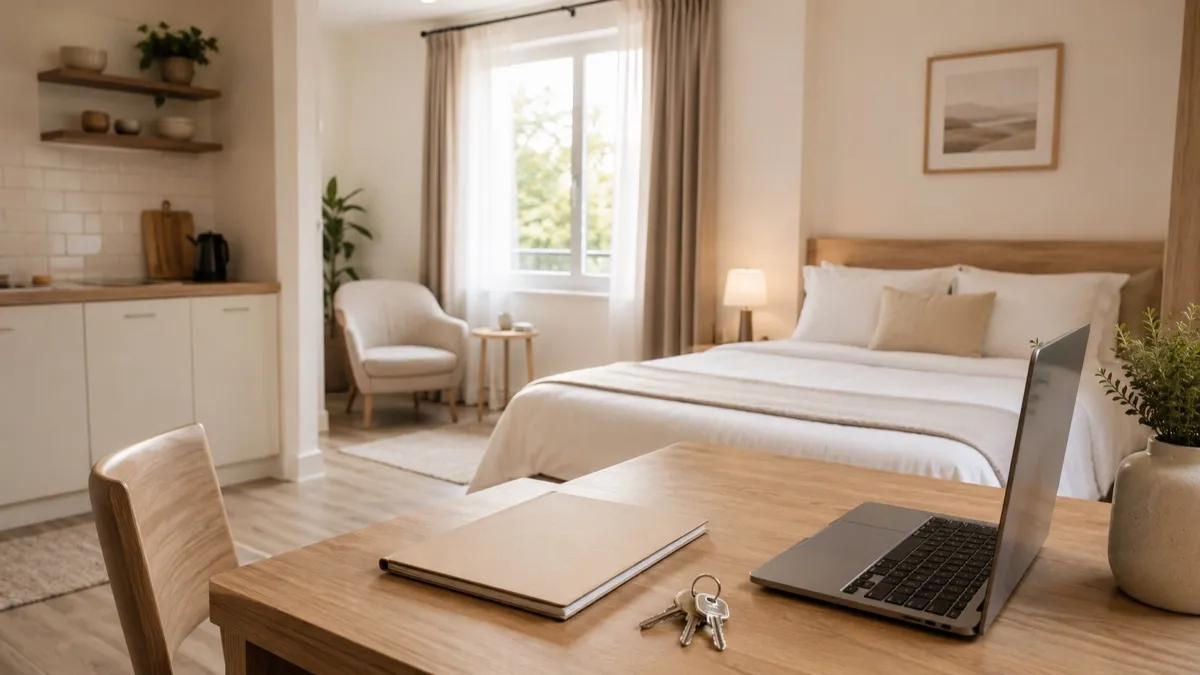
When an owner decides to rent out a property in Slovenia short-term, the question of a management model arises. Doing everything yourself while living abroad is physically impossible. So you need help — and here there are two main paths: hand everything to a short-term rental operator, or run the rental yourself and outsource only the operational part.
This article compares the two models on the substance: how each one works, what you hand over and what you keep, what it costs in logic (not in specific numbers), and who each one suits.
This piece draws on practice in the short-term rental market and on the DomCare team’s years of experience in operational support for rental properties in Slovenia.
To compare the models, let’s break a rental down into tasks. There are two types.
Commercial tasks: posting and running the listing, photographs, the description, pricing, calendar management and platform synchronisation, communicating with guests at the booking stage, working with reviews, reporting.
Operational (physical) tasks: cleaning and changing linen between guests, check-in and access, responding to breakdowns and problems, restocking consumables, responding to emergencies.
The difference between the two models lies in who takes on the commercial part.
A short-term rental operator (a management company) takes on the whole cycle — both the commercial and the operational side. You hand over the property; the operator does everything: listing, prices, guests, cleaning, problems. You receive the income minus the operator’s commission (on the market this is usually 15–25% of revenue).
Pros: minimal involvement from you — close to genuinely “passive income”; nothing to learn; a single point of responsibility.
Cons: a noticeable share of revenue goes to the operator; less control over how your property is presented and serviced; you don’t manage the prices or the strategy; quality depends entirely on how good the particular operator is; your property is one of many in their portfolio.
You run the commercial part yourself — listing, prices, guest communication — and you outsource the operational part to a local support service: cleaning, keys, check-in, responding to problems. What can’t be done from another country is handled by support; what can be done remotely, you keep for yourself.
Pros: you keep a larger share of the revenue; full control over how the property is presented and over the pricing strategy; you know your guests and your operation directly; flexibility — you can configure exactly the set of support you need.
Cons: it requires your involvement — a few hours a week on the commercial part; you need to learn the platforms and the basic rules; you’re the coordinator, not an operator.
| Operator | Self-managed + support | |
|---|---|---|
| Commercial part (listing, prices, guests) | Operator | You |
| Operational part (cleaning, keys, problems) | Operator | Support service |
| Your involvement | Minimal | A few hours a week |
| Share of revenue to operator/service | Percentage of revenue (usually 15–25%) | Payment for operational services, not a revenue share |
| Control over the property | Low | High |
| Control over prices | None | Full |
| Whose property it “is” in the work | One of the operator’s portfolio | Yours, in focus |
| Barrier to entry | Low | Medium |
The fundamental difference is in the economics: an operator takes a share of revenue, while support takes payment for specific operational services. With good occupancy, a percentage of revenue can come to a significant sum; payment for operational services doesn’t depend on revenue.
An operator suits you if: you want minimal involvement and are willing to pay for it with a share of revenue; you have neither the time nor the desire to learn the platforms; “not having to think about it” matters to you more than maximising income; you’re trying renting for the first time and don’t want to dive in deep.
“Self-managed + support” suits you if: you want to keep most of the income; control over how the property is presented and serviced matters to you; you’re willing to give the rental a few hours a week; you see the rental as a small business rather than a fully passive arrangement.
There’s also an in-between path: run the commercial side yourself, but reinforce operational support in the high season, when the load is at its peak. The “self-managed + support” model is flexible exactly for this — the volume of support can be adjusted.
The wider context of short-term rentals — what’s needed to launch, the legal side, seasonality — is covered in our guide to short-term rentals.
DomCare works on the “self-managed + support” model. We’re not an operator: we don’t run your listing, we don’t communicate with guests on your behalf, and we don’t take a share of revenue. We cover the operational, physical part — short-term rental support: cleaning between guests (cleaning), access and key holding, responding to breakdowns and emergencies. You remain the owner of your rental, its income and its strategy — we take on what can’t be done from another country. The volume of support is adjusted to your season and needs.
The easiest way to discuss it: write to us through the form or on WhatsApp.
Which is better value — an operator or support? It depends on occupancy. An operator takes a percentage of revenue, so with good occupancy their commission is a noticeable sum. Support is paid for specific operational services and doesn’t depend on revenue. With an actively rented property, the “self-managed + support” model usually leaves the owner with more.
How much time does the “self-managed + support” model take? The commercial part — listing, prices, correspondence with guests — is on the order of a few hours a week, more in the high season. The operational part is covered by support.
Can you start with an operator and then switch to self-management? Yes. Many people try renting through an operator, get the hang of it, and then move to “self-managed + support” to take back control and a share of the income.
How is a support service different from an operator? An operator runs the whole cycle, including the commercial side, and takes a share of revenue. A support service covers only the operational, physical part, while the owner runs the commercial side themselves.
Does the “self-managed + support” model work if I live abroad? Yes — it was created precisely for this: you run the commercial part from anywhere, while the physical part — cleaning, keys, response — is covered by local support.
The choice between an operator and the “self-managed + support” model is a choice between “minimal involvement for a share of revenue” and “control and income for a few hours a week.” An operator is good when not having to think about it is what matters. Support is good when you want to remain the owner of your rental. Neither model is “more correct” — the right one is the one that matches how much you’re willing to put in.
Want to work out which model suits your property — write to us.
Why upholstery and mattress cleaning prices in Slovenia differ fourfold, how dry UV treatment differs from extraction, and what you're actually paying for.
What works out better for garden care in Slovenia — a seasonal subscription or one-off visits as needed — and how to choose the right format for your type of grounds.
When a property task in Slovenia really is worth flying in for yourself, and when the matter is cheaper and faster to handle remotely through a trusted person on the ground.
Tell us about your situation — we'll agree on the format and a fixed price. The first assessment visit is free.