Moving Furniture Within a Property: 6 Situations When You Need It
What moving furniture within an apartment or house in Slovenia means: the 6 situations when you need it, what the service covers, and how it differs from a full move.
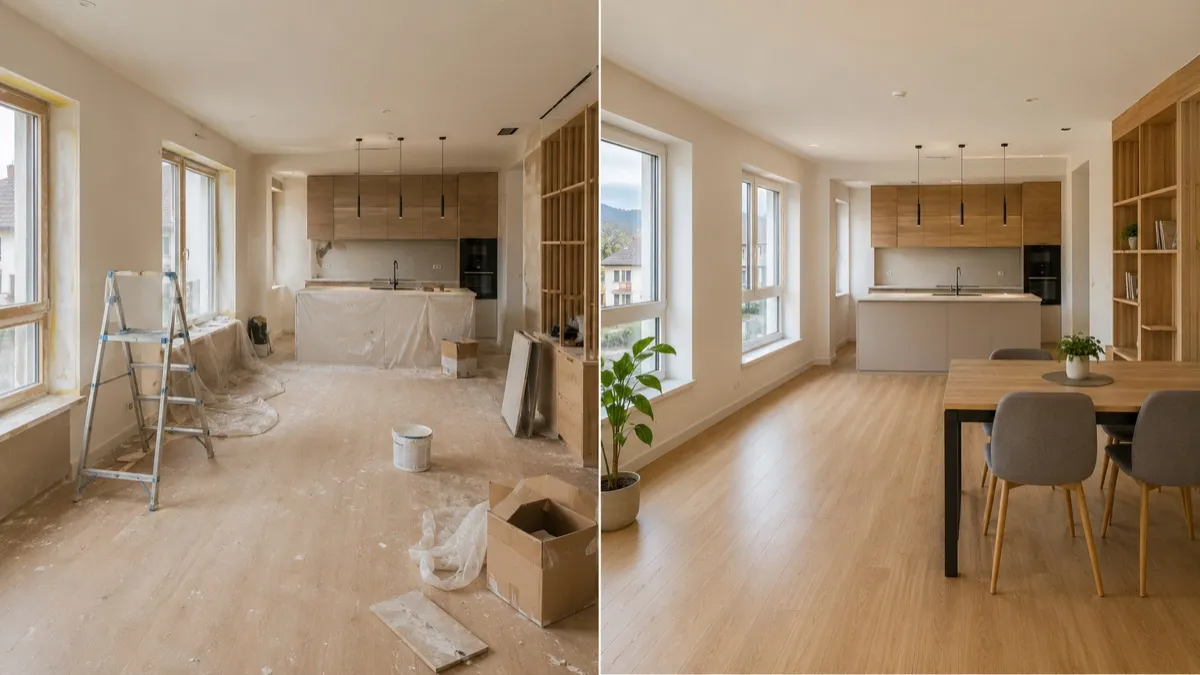
The renovation is finished, the contractors have left — but the apartment isn’t ready for life yet. A thin layer of construction dust covers everything: windowsills, the insides of cabinets, skirting boards, light fixtures, even items in closed drawers. There are paint marks on the glass, grout streaks on the tiles, a whitish haze of cement on the floor. A regular clean can’t handle this. You need post-renovation cleaning — a separate service with its own technique.
This article is about what post-renovation cleaning is, what it includes, how its stages work, and what to realistically expect in terms of time and result. If you’re renovating in Slovenia remotely or preparing a property for move-in, this will help you plan the finish properly.
This material draws on professional cleaning practice and years of experience from the DomCare team cleaning properties after renovations in Slovenia.
The main reason is construction dust. This is not household dust. Particles of cement, plaster, sanded render, wood dust — tiny, light, they rise into the air at any movement and settle again. The dust gets into every crack, into the ventilation, behind furniture, inside cabinets.
That’s why post-renovation cleaning can’t be done “like a regular clean, just more thoroughly.” It needs a different approach (top to bottom, repeatedly, in the right sequence), different products (for removing cement, paint, glue, grout), a professional vacuum that filters fine particles. An ordinary damp cloth simply smears construction dust around rather than removing it.
The second reason is specific residues: paint splashes, traces of expanding foam, stickers and protective film on appliances and double-glazed windows, grout left on tiles, silicone runs. Each needs its own removal method, one that doesn’t damage the surface.
A typical scope of the service:
Professional post-renovation cleaning is usually split into two stages, and understanding this helps with planning.
The rough (initial) clean — right after the work is finished. The main debris, coarse dust and obvious residues are removed. After it the property is no longer a “building site,” but it isn’t ready for move-in: fine dust will keep settling.
The final clean — some time after the rough one, once all the airborne dust has settled. This is bringing it to a “ready to live in” state: a second dedusting, the windows, the detailed work.
Two stages aren’t a whim — it’s working with the physics of dust. If you do the cleaning in a single pass right after the renovation, within a day or two a whitish film will reappear on the clean surfaces from dust that was still hanging in the air.
Time. Post-renovation cleaning is significantly longer than a regular clean — for a standard apartment it’s usually not a couple of hours but a full working day with a team, sometimes split across two visits (rough and final).
Result. A realistic expectation is a property fully ready for move-in: no dust, no construction traces, surfaces clean and undamaged. What post-renovation cleaning does not do: it doesn’t fix the flaws of the renovation itself (uneven painting, poor grouting), it doesn’t remove defects ingrained in the material, and it doesn’t replace inspecting and accepting the contractors’ work.
The cost depends on the area, the state of the property and the volume of residue — current rates are on the service page.
Post-renovation cleaning is the final chord, but it makes sense to view it alongside the whole project. If you ran the renovation remotely, someone on the ground had to inspect and accept the contractors’ work, check the quality, record any shortcomings — that’s Contractor Support. Post-renovation cleaning fits naturally into the same process: the same people who oversaw the build also organise the final clean and the preparation of the property for move-in or letting.
And if the renovation was part of looking after the property on a subscription, post-renovation cleaning is simply one episode of Property Care.
At DomCare, post-renovation cleaning is part of the Cleaning service — its own format with its own technique and scope of work. We can organise both stages (rough and final), coordinate them with your contractors’ schedule, and prepare the property for move-in or for letting — even when you aren’t in Slovenia. We work in Ljubljana, on the Slovenian Coast, in the Bled and Bohinj region, and in the Kranj region.
The easiest way to talk it through: send us a message via the form or on WhatsApp.
How is post-renovation cleaning different from a regular deep clean? In technique and products. Construction dust and specific residues (paint, grout, film) need a particular approach, sequence and professional equipment. A regular clean smears construction dust around rather than removing it.
Do you need two stages, or can it be done in one go? Ideally two: a rough clean right after the work and a final clean once all the dust has settled. In a single pass the result is worse: a film reappears on the clean surfaces from dust that was hanging in the air.
Does post-renovation cleaning include hauling away construction debris? Usually no. Hauling away bulky construction debris is a separate task, best left to the contractors. Post-renovation cleaning is the cleaning of surfaces and dedusting.
How long does post-renovation cleaning take? Significantly longer than a regular clean — usually a full working day with a team for a standard apartment, sometimes split across two visits.
Can I order post-renovation cleaning if I’m not in Slovenia? Yes, this is a typical situation. You just need to arrange access to the property — through Key Holding or Property Care — and coordinate the schedule with the contractors.
Post-renovation cleaning isn’t “a regular clean, just more thorough” but a separate service with its own technique for working with construction dust. Build it into the renovation plan in advance, allow for two stages and access to the property — and the apartment will greet you or your guests ready for life.
Want to organise post-renovation cleaning for your property — send us a message.
What moving furniture within an apartment or house in Slovenia means: the 6 situations when you need it, what the service covers, and how it differs from a full move.
What property clearing in Slovenia is, how the process works, the situations where it's needed, and how to approach clearing an inherited home with care.
A closed-up apartment is in a state of dormancy. How to properly start up a home after a long absence and shut it down sensibly when you leave — without smells or breakdowns.
Tell us about your situation — we'll agree on the format and a fixed price. The first assessment visit is free.