A Coastal Home from October to March: Off-Season Without Damage
How to prepare a home on the Slovenian Coast for the off-season and get it through unharmed: the risks of the bora wind, salt air and damp from October to March.
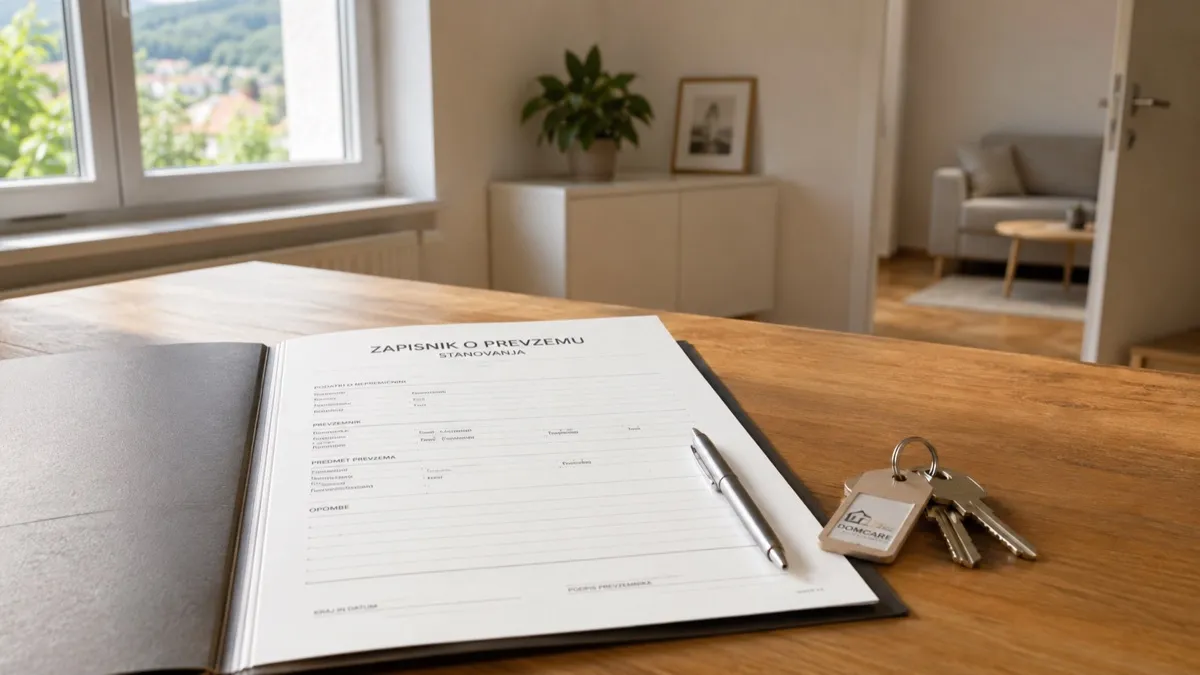
Long-term rental looks like a simple form of passive income: one tenant for a year or more, a fixed rent, minimal fuss. And so it is — most of the time. But long-term rental has two critical points that decide whether it stays calm: the handover at move-in and the return at move-out. And both of those points require a presence on the ground — while you’re abroad.
This article is about how to organise these two moments, and the oversight in between, if you let an apartment in Slovenia remotely.
Important: this article contains no legal recommendations on the rental contract. Drawing up the contract, the rights and obligations of the parties, the deposit, registration — that’s the work of the estate agent (posrednik) and lawyer (advokat). We’re talking about the physical, operational side.
The article draws on Slovenian rental practice and on years of experience from the DomCare team in operational support for rented properties.
Unlike short-term rental, with its flow of guests and constant operations, long-term rental looks calm on the surface. But the owner’s distance creates three vulnerable points.
The first is move-in: you need to physically hand the apartment over to the tenant and record its condition. The second is oversight during the tenancy: you can’t see what’s happening to the apartment for a year; if something goes wrong, you find out late. The third is move-out: you need to take the apartment back, assess its condition, sort out the deposit — and again, someone has to be on the ground.
Between these points, an owner living abroad is effectively “blind” — and a year of tenancy is a long time.
The moment of move-in decides half of the future disputes. Do it right, and at move-out you’ll have something to lean on.
Record the condition of the apartment. Before the keys are handed over, someone on the ground photographs the apartment in detail: every room, the condition of the walls, floors, windows, plumbing, appliances, furniture. This is the baseline against which the condition at move-out will be compared.
Read the meters. Water, electricity, gas — recorded on the handover date.
Draw up an inventory. What is handed over with the apartment — furniture, appliances, in what condition. This is part of the handover record (its form and legal side are provided by the estate agent or lawyer, while the physical record comes from a presence on the ground).
Hand over the apartment and keys. A meeting with the tenant, the key handover, the walk-through: where the main valve is, how the heating works, what’s important to know. A calm, well-informed tenant means fewer problems down the line.
Check that the property is ready. Before move-in, the apartment should be cleaned and in working order — minor faults fixed (Repairs & Handyman).
All of this is done in one or two visits — essentially a One-off Visit for the handover.
A year of tenancy is not “nothing”. Over that time:
If you have no representative on the ground, you try to sort out every such case by phone from another country, without seeing the situation. That’s why many owners keep a let apartment under light Property Care, or at least under Key Holding — so there’s someone to respond. Property care doesn’t interfere with the tenant’s life; it serves as your channel for responding to whatever falls within the owner’s area.
But oversight during the tenancy isn’t only about responding to what has already happened. In our experience, it’s very useful for someone to calmly inspect the apartment in person every few months — the owner during a visit, or a trusted person by arrangement with the tenant. A scheduled visit like this works in several directions at once. It gently keeps things in order: a tenant who knows the apartment is checked from time to time treats it more carefully. It allows you to notice what doesn’t make it into complaints — careless handling, breakdowns starting up, leaks and problems the tenant simply doesn’t report. And it’s also a natural occasion to read and reconcile the meters, collect the accumulated post, and check the condition of whatever falls within the owner’s area. This isn’t surveillance or intrusion into private life, but an ordinary scheduled check by agreement — and it’s the one that most often catches a problem while it’s still small and cheap to fix.
Move-out is the second critical point and the main source of disputes (usually around the deposit and the condition of the apartment).
Take the apartment back physically. Someone on the ground inspects the apartment after the tenant has moved out and compares it with the condition recorded at move-in.
Compare against the photographs. Those same shots from move-in now do their job: you can see what has changed, what is natural wear and what is damage.
Read the meters. Final readings for the settlement.
Record the result. The condition at move-out is documented with photographs — this is the basis for the deposit decision.
The deposit decision. Withholding the deposit (in full or in part) is a matter of the contract and, in a dispute, the lawyer. But the factual basis for that decision is an objective record of the condition, and that comes from a presence on the ground.
Without an independent record of “before” and “after”, a dispute over the deposit turns into “one person’s word against another’s” — and the owner who’s abroad loses it.
When one tenant has moved out and another hasn’t yet moved in, the apartment has a window, and it’s worth using:
This window is the best time to put the apartment in order, because afterwards it’s occupied again for a year.
DomCare covers the physical side of long-term rental for a remote owner. The handover at move-in and the return at move-out — with a detailed photo record of the condition — are carried out as a One-off Visit. Responding to problems during the tenancy is handled by Property Care or Key Holding. Between tenants — Cleaning and Repairs & Handyman. We don’t draw up the rental contract or handle the legal side — that’s the estate agent and lawyer; we provide the presence on the ground and the objective record. We work in Ljubljana, on the Slovenian Coast, in the Bled and Bohinj region, and in the Kranj region.
The easiest way to talk it through: message us through the form or on WhatsApp.
Why record the condition of the apartment when the tenant moves in? So you have something to compare against at move-out. Detailed photographs on the handover date are an objective basis for the deposit decision and protection against a word-against-word dispute.
Can the handover and return be organised if I’m abroad? Yes. The physical record of condition, the key handover and the apartment walk-through are done by a representative on the ground. The legal form of the record is provided by the estate agent or lawyer.
Does an apartment let for a year need property care? Full regular property care isn’t essential — a tenant is living in the apartment. But it’s useful for the owner to have a channel for response on the ground — light property care or key holding — in case of emergencies and problems that fall within the owner’s area.
Who decides the deposit question at move-out? The deposit decision is a matter of the rental contract and, in a dispute, the lawyer. But the factual basis for the decision is an objective record of the apartment’s condition “before” and “after”, which a presence on the ground provides.
What should be done between tenants? Use the window for a deep clean, for dealing with accumulated wear, and for a full inspection before the next move-in — while the apartment is free.
Long-term rental is calm most of the time, but it rests on two critical points — the handover at move-in and the return at move-out. Both require a presence on the ground and an objective record of condition. Organise these two points properly, provide a channel for response in between — and remote letting will bring in income without disputes or surprises.
If you let an apartment in Slovenia and live abroad — message us, and we’ll help with the handover, oversight and return.
How to prepare a home on the Slovenian Coast for the off-season and get it through unharmed: the risks of the bora wind, salt air and damp from October to March.
How an owner abroad can keep control of an apartment renovation in Slovenia: what to lock in before the start, the rhythm of oversight, milestone sign-offs and the typical mistakes.
Which winter risks threaten an Alpine home in the Bled and Bohinj area, what should be happening to it while you're away, and how to arrange winter property care.
Tell us about your situation — we'll agree on the format and a fixed price. The first assessment visit is free.