When to clean your mattress: signs, timing, dust mites
How to tell your mattress needs cleaning, why dust mites live in the mattress, what timing to treat as normal, and what actually helps with allergies.
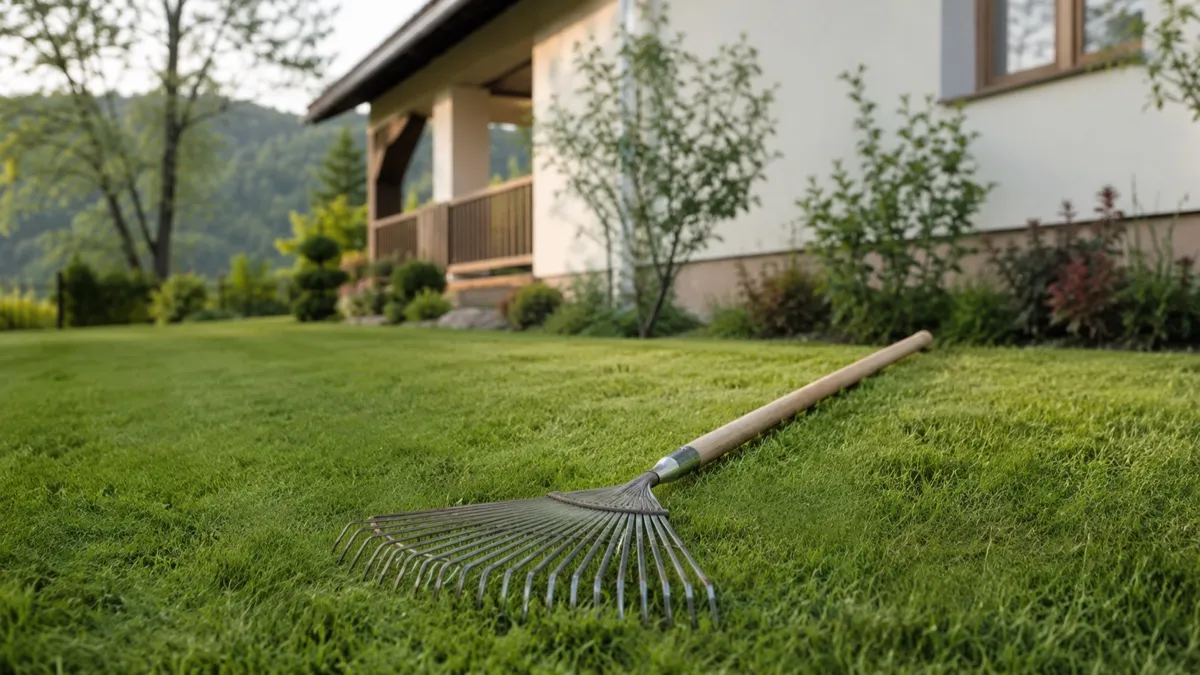
As soon as you start taking your lawn seriously, a barrage of words comes at you: aeration, scarification, mulching, feeding, liming. It sounds like professional agronomy, but behind each term is a simple, understandable procedure. And almost all of them are part of ordinary seasonal garden care.
This article is a short breakdown: what each word means, why the job matters, and — most importantly — how to do it properly. Because all these jobs share the same catch: the equipment is simple and can be hired for a couple of hours, but the result depends not on the machine, but on the season, the dosage and the order of work.
This piece draws on seasonal lawn-care practice in the Slovenian climate and on the DomCare team’s experience maintaining gardens at private homes.
Almost any of the procedures below can be done with hired equipment — a scarifier and an aerator can be rented, and fertiliser is sold in any garden shop. So it seems the only question is getting hold of the machine. In reality — no.
Each job has three “rights” that the machine doesn’t provide:
What follows is each term in turn. Keep these three “rights” in mind: they — not hiring the machine — are the whole difference between a well-kept lawn and a ruined one.
What it is. Removing “thatch” — a dense layer of dead grass, moss and plant debris that builds up between the green grass and the soil.
Why. Thatch works like a waterproof layer: it blocks water, air and nutrients from reaching the roots, holds damp, and encourages disease. A lawn with thick thatch yellows, thins out and looks tired even with regular mowing.
How to do it right. In spring or autumn, never in the summer heat. The lawn should be slightly moist, not wet. The depth is set to comb out the thatch, not to tear up the turf. Right after scarification the lawn looks ragged — that’s normal, it recovers. Scarification is almost always followed by overseeding the bared patches.
What it is. Puncturing the soil or pulling out small soil plugs so that channels for air, water and nutrients appear in the compacted ground.
Why. The soil under a lawn compacts over time — from foot traffic, machinery, rain. In compacted ground the roots suffocate and water stands on the surface. Aeration relieves that compaction.
How to do it right. The soil should be moderately moist: an aerator simply won’t bite into dry soil, and it will smear waterlogged soil. Aeration is usually done together with scarification and right after it. The season is spring or autumn. On a heavily trodden plot, full aeration with soil-plug removal works better than a simple spike puncture.
What it is. Sowing grass seed into bare patches, worn paths and thinned areas.
Why. Bare patches won’t grow back with the right grass on their own — weeds and moss are the first to take the open space. Overseeding restores the lawn’s density.
How to do it right. The best time for overseeding is right after scarification and aeration: the seed lands not on thatch, but on open soil that it can make contact with. After sowing, the area is kept moist until the seedlings come up. The season is spring or early autumn, when the soil is warm enough for germination.
What it is. Applying fertilisers that replenish the nutrients the lawn has used up.
Why. A lawn constantly draws nutrients out of the soil. Spring feeding gives it the strength to grow; autumn feeding strengthens the roots and prepares the grass for winter.
How to do it right. The formula must suit the season — spring and autumn fertilisers are different, and you can’t swap them. The dose must be strictly to the recommended rate: an overdose “burns” the lawn in yellow patches and streaks. Apply it evenly, and not before heavy rain (which washes it away) or in a drought.
What it is. Applying lime to lower the soil’s acidity.
Why. Over time, the soil on many plots in Slovenia turns acidic. In an acidic environment, grass grows worse and moss spreads vigorously — and moss is often the first signal that it’s time. Liming restores a normal balance to the soil.
How to do it right. Only as needed — ideally after a soil acidity test, not “just in case”: over-limed soil harms a lawn no less than acidic soil. The season is autumn or early spring. And lime isn’t applied at the same time as certain fertilisers — the jobs are spaced apart in time.
What it is. Covering open soil with a protective layer — bark, wood chips, compost — on flower beds and around the bases of trees. Mulching mowing belongs here too, when finely chopped grass is left on the lawn.
Why. Mulch holds moisture, stops weeds from sprouting, protects roots from heat and cold, and — as it breaks down — feeds the soil.
How to do it right. The thickness of the layer matters: too thin and it doesn’t work, too thick and it rots. Mulch isn’t piled right up against a tree’s trunk — that encourages bark rot. The material is matched to the task, and the layer is refreshed once a season.
None of these procedures requires special skill. The difficulty is elsewhere: they’re all tied to the season, to the state of the soil and to one another. Scarification and aeration have to be fitted into a short spring or autumn window. Overseeding only makes sense right after them. Liming can’t be combined with feeding. And a lawn in Slovenia doesn’t wait for the owner to find a free week — especially if the owner is in another country altogether.
So these jobs are either done in one well-planned visit, or built into a schedule of regular garden care. You can gather the equipment and do it all yourself. Or you can hand it to people for whom the lawn’s seasonal calendar is routine.
At DomCare, scarification, aeration, overseeding, feeding, liming and mulching are part of garden and outdoor care as specialised lawn and soil work. They’re done as one-off jobs or built into a schedule of regular care — so that each one falls in its right season and in the correct order relative to the rest. The cost is calculated by the size of the plot; current rates are on the service page. For owners who are only in Slovenia from time to time, this is part of the wider logic of property and garden care: the lawn is kept in shape year-round, not just during your visits. We work in Ljubljana, on the Coast, in the Bled and Bohinj region and in the Kranj region.
The easiest way to discuss it: write to us through the form or on WhatsApp.
How is aeration different from scarification? Scarification works on the surface — it combs out the thatch between the grass and the soil. Aeration works on the soil itself — it opens channels in it for air and water. They’re often done together: scarification first, then aeration.
When should you scarify and aerate a lawn? In spring or autumn, depending on the state of the lawn. These jobs aren’t done in the summer heat — a damaged lawn doesn’t have time to recover. The soil should be slightly moist: not dried out and not waterlogged.
Can you aerate and scarify a lawn yourself? Yes — the equipment can be hired, and the machinery itself isn’t complicated. The difficulty isn’t the machine, but choosing the right season, setting the right depth and following the correct order of work. A lawn is ruined by a mistake in exactly that, not in the machinery.
Does a lawn need liming every year? No. Liming is done as needed — when the soil has become acidic, which a spread of moss often signals. Ideally, after an acidity test. Over-liming also does harm.
What is mulching mowing? It’s a cut in which the grass is chopped into fine crumbs and left on the lawn as a thin mulch — it holds moisture and feeds the soil. It’s important that the layer really is fine: coarse clippings rot and smother the lawn.
Aeration, scarification, mulching and the jobs alongside them aren’t agronomy for specialists — they’re understandable seasonal lawn care. But for each of them the result is decided not by the equipment, but by three “rights”: the right season, the right amount, the right order. Doing it yourself is realistic — you just need to not miss on those three.
Want the lawn on your plot to get this work on time and in the right order — write to us, and we’ll find the right format for your garden.
How to tell your mattress needs cleaning, why dust mites live in the mattress, what timing to treat as normal, and what actually helps with allergies.
How to work out what makes more sense for your property in Slovenia — a Property Care subscription or one-off visits as tasks arise. The logic of the break-even point and what to compare beyond money.
An honest breakdown of the cost of maintaining an apartment in Slovenia under remote ownership: mandatory payments, seasonal costs and the hidden expenses people forget.
Tell us about your situation — we'll agree on the format and a fixed price. The first assessment visit is free.