When to clean your mattress: signs, timing, dust mites
How to tell your mattress needs cleaning, why dust mites live in the mattress, what timing to treat as normal, and what actually helps with allergies.
When people work out the budget for buying property in Slovenia, they usually think about the price of the property, the transaction tax and the notary’s fees. But what comes next — how much the property costs every year simply by virtue of ownership — often stays vague. Especially if you do not live in the country and do not see the bills with your own eyes.
This article is an honest breakdown of the cost of maintaining an apartment in Slovenia under remote ownership: what it is made up of, which payments are mandatory, which appear seasonally, and — most importantly — which costs are hidden, that is, the ones forgotten at the planning stage.
Important: we do not quote specific DomCare rates here — those are on the service page. This is about an owner’s costs in general: utility bills, third-party services and the overall logic of the budget. We do not cover taxes either — that is a question for an accountant (računovodja — Slovenian for accountant).
The material draws on Slovenian housing legislation (Stanovanjski zakon — the Housing Act), the energy-efficiency recommendations of Eko sklad and the long-standing experience of the DomCare team caring for the properties of remote owners.
The cost of maintaining an apartment is convenient to break into four layers:
The first two layers apply to any owner, local or remote. The third is specific to remote ownership, and it is the one most often underestimated. The fourth is a decision that largely neutralises the third.
The base layer, which exists even if no one lives in the apartment.
Shared building utilities — water, waste collection, maintenance of common parts, stairwell lighting. For a standard apartment in Ljubljana this is around €50–90 a month, depending on the building and the floor area.
Electricity — even an empty apartment has a baseline draw (the fridge, if it is on, standby appliances, holding the temperature in winter). From €40 to €80 a month, higher in winter.
Heating — the most variable item. In winter €60–150 a month, in summer close to zero. In an empty apartment, heating is usually kept at the minimum frost protection, but switching it off entirely is risky.
The building manager’s fee (upravnik — Slovenian for building manager) — for managing the building. Usually €5–15 a month.
The building’s reserve fund (rezervni sklad — reserve fund) — savings for future repairs of the common parts. Usually €10–30 a month, depending on the building.
Connectivity — if you keep the internet on (for the convenience of a service, smart devices, future guests), that is another €25–35 a month.
These are not our prices but a typical market picture of a Slovenian owner’s payments. In total, the base layer for a standard apartment is roughly €2,000–2,800 a year; for a house with grounds it is noticeably higher.
Payments that do not come every month but come regularly — and that are easy to forget at the planning stage.
Property insurance — an annual policy. On the market, for an apartment this is usually €150–400 a year, depending on the cover and the property.
The annual chimney inspection — mandatory by law for properties with a heating appliance. A chimney sweep’s work is usually €40–80.
Servicing the boiler or heating equipment — recommended annually. A specialist’s service runs around €60–120.
Servicing the heat pump, alarm, air conditioner — if you have them, each requires periodic maintenance.
Seasonal preparation — preparing for winter, opening the season. This is either your time or paid work.
All the figures listed are market prices of third-party specialists, not our rates. They are useful as a guide: the seasonal-annual layer adds another few hundred euros a year to the budget.
And here is the most interesting and most underestimated part. These are costs that arise precisely because you are not on site.
Trips for everyday tasks. The boiler needs to be let in for a service, furniture has been delivered, the apartment must be opened for an estate agent. If you have no local helper, every such task is a flight, and sometimes an overnight stay. A single round-trip ticket just to let in a technician can easily exceed the annual cost of basic property care. Asking a neighbour or relative is the obvious idea, but here too it is not so simple: more on this in our article on key holding.
The premium for urgency. When you do not control the situation in advance, much of it gets resolved in “emergency” mode. An urgent call-out, express delivery, an emergency service — all of it costs more than a planned job. A remote owner without support systematically overpays for urgency.
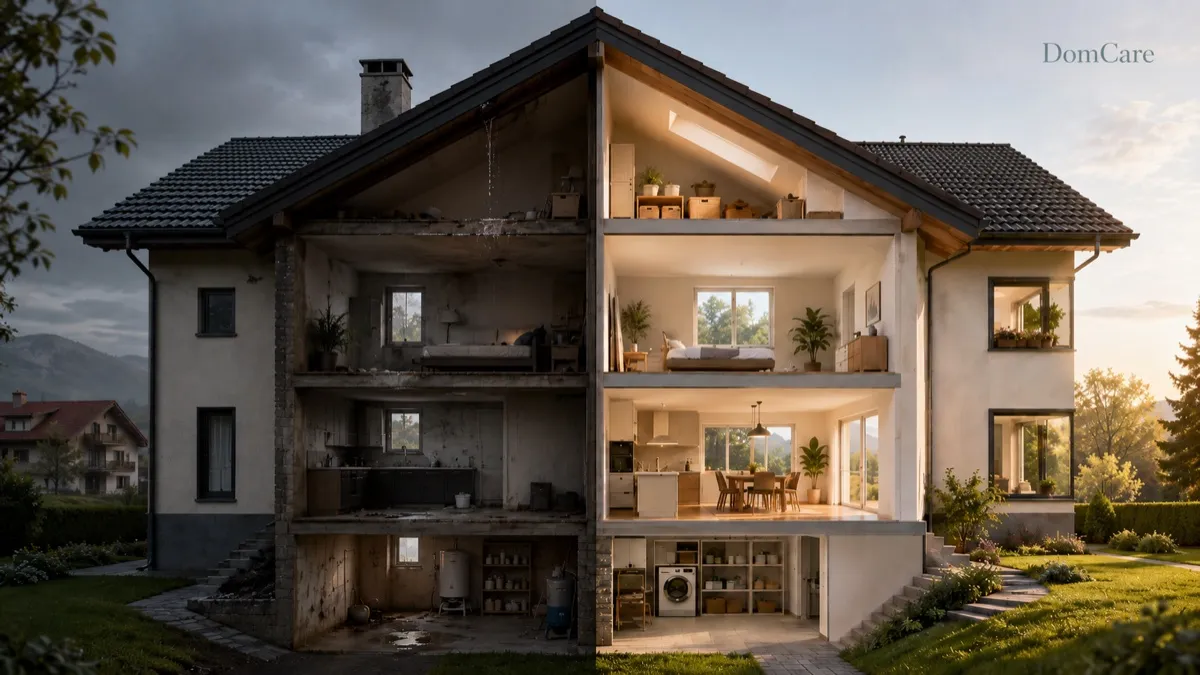
The cost of an unnoticed problem. The most expensive category. A leak that a local resident would spot within a day develops for months in an empty apartment. A dripping tap is a grown water bill. Damp is mould and a repair. A small leak is a ruined floor and the ceiling of the neighbours below. These costs are in no one’s budget, yet they are exactly what fires off in large sums.
Missed deadlines. Insurance not renewed on time, a mandatory inspection skipped — and in the event of an incident the insurer reduces or rejects the payout. A missed deadline costs more than the service itself.
Exchange-rate and transfer losses. Paying from another country, transfers, currency conversion — small but regular losses.
Hidden costs are treacherous because they cannot be put into a table in advance: they are zero one year and a great deal the next. But averaged over the years they are always there — and for a remote owner without local support they are the heaviest and most unpredictable part of the costs.
At first glance, a Property Care subscription is an extra cost on top of all the others. But it is more honest to look at it differently: property care replaces the remote owner’s hidden costs with a more predictable, and usually smaller, figure.
Compare the logic. Without care: unpredictable flights for everyday tasks, overpaying for urgency, the risk of an expensive unnoticed problem, the risk of missed deadlines. With care: a fixed monthly figure, known in advance, plus separate payment for specific work — but with no flights, no emergencies, and early detection of problems.
Property care is not added to the hidden costs — it largely replaces them. So the right question is not “what does property care cost” but “what does its absence cost me”. For more on where the value threshold lies, see the separate article on subscription versus one-off visits.
DomCare’s specific property care rates are on the service page; in this article we deliberately do not quote figures, so as not to mislead if they change.
Let us add up the layers as a guide — using the example of a standard apartment in Ljubljana, with no major repairs:
For a house with grounds, all the layers are higher: a larger area to heat, more elements that wear out, plus the added costs of the garden and yard.
The main takeaway from the picture: the predictable part of the budget is moderate, while the unpredictable part (the hidden costs) is exactly what makes remote ownership expensive. Managing that unpredictability is the owner’s core financial task.
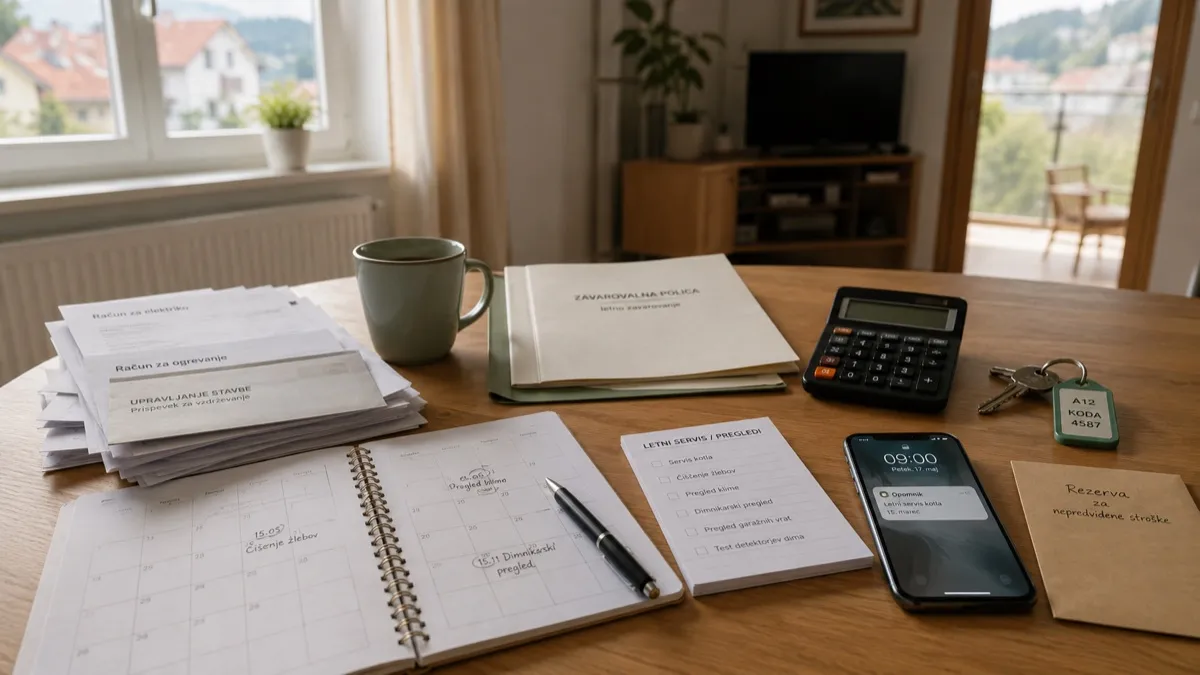
Automate payments. A direct debit (trajni nalog — standing order) from a local account removes the risk of missed payments and arrears.
Keep a calendar of mandatory dates. Insurance, the chimney inspection, the boiler service — enter them as annual reminders. A missed deadline costs more than the service.
Do not skimp on early detection. A regular inspection is the cheapest way to keep an expensive problem from happening. This works both with a subscription and if a trusted person simply drops by regularly.
Count by the year, not by the month. Seasonal peaks (winter heating) and annual payments need to be averaged out, or the budget will keep “surprising” you.
Keep a reserve. 5–10% of annual costs as a cushion for an unforeseen repair. A property will always, one day, need something.
We do not reduce utility bills — they do not depend on us. But we work directly with the layer of hidden costs: regular Property Care detects problems early, while they are still cheap; removes the need for flights for everyday tasks; keeps a calendar of seasonal dates; and coordinates contractors at planned, not urgent, rates. Related services — cleaning, garden care, the One-off Visit — close specific tasks without your presence.
Current rates are on the service page. The initial inspection of the property before a subscription is free.
The simplest way to talk it through: write to us via the form or on WhatsApp.
On average, what does it cost to maintain an apartment in Slovenia per year? Basic payments for a standard apartment run roughly €2,000–2,800 a year, plus a few hundred euros for seasonal services and insurance. This is before taxes and the remote owner’s hidden costs, which depend heavily on the situation.
Which costs do people most often forget to account for? The remote owner’s hidden costs: trips for everyday tasks, overpaying for urgency, and — the most expensive — the cost of a problem noticed too late.
Is a house more expensive to maintain than an apartment? Yes, noticeably. A larger area to heat, more elements outside that wear out, plus the added costs of the grounds and garden. Roughly, maintaining a house works out 30–60% more expensive than a comparable apartment.
Is property care an extra cost? More a replacement cost. A Property Care subscription replaces unpredictable hidden costs with a more predictable figure. The right question is not “what does property care cost” but “what does its absence cost”.
Can I find out the exact rates for property care? Yes, DomCare’s current rates are always published on the service page. We do not quote specific figures in articles, because prices can change, while the service page is kept up to date.
Maintaining an apartment in Slovenia is not one figure but four layers of costs. The predictable layers are moderate. What makes remote ownership expensive is the layer of hidden costs — trips, urgency, unnoticed problems. Whoever manages that layer keeps the budget under control.
Want to estimate the costs for your specific property — write to us, and we will break your situation down layer by layer.
How to tell your mattress needs cleaning, why dust mites live in the mattress, what timing to treat as normal, and what actually helps with allergies.
Aeration, scarification, mulching, feeding, liming, overseeding — what these lawn jobs are in Slovenia, why they matter, and how to do each one properly.
How to work out what makes more sense for your property in Slovenia — a Property Care subscription or one-off visits as tasks arise. The logic of the break-even point and what to compare beyond money.
Tell us about your situation — we'll agree on the format and a fixed price. The first assessment visit is free.